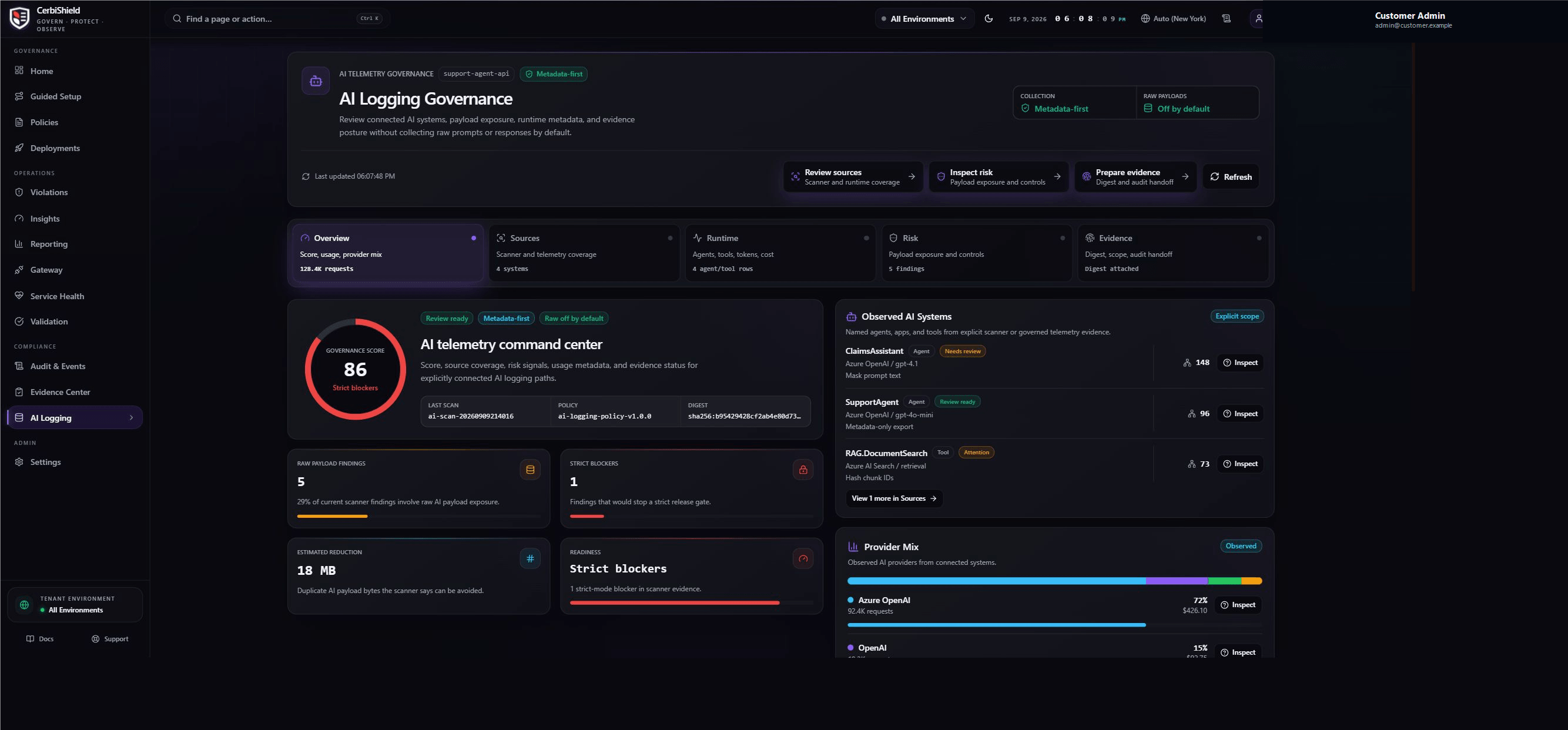
CerbiShield DashboardCurrent release-candidate UI

The control plane should answer operational questions.

CerbiShield is where policy becomes an operated control: define it, validate it, target it, deploy it, observe what happens, and retain the evidence needed to explain the outcome later.

01

Define

Create or select a governance rule/profile.

02

Validate

Test the policy before changing live enforcement.

03

Target

Choose the workload and environment the policy should govern.

04

Deploy

Publish policy to the selected CerbiStream or Gateway enforcement boundary.

05

Observe

Review violations, posture, health, and operational signals.

06

Prove

Use evidence, reports, and audit context to explain the control afterward.

Real release-preview screens, explained in place.

Hover, focus, or tap the numbered points. These are real August Dashboard captures. The preview was not connected to a live customer Azure deployment, so empty states are preserved instead of being replaced with fabricated production activity.

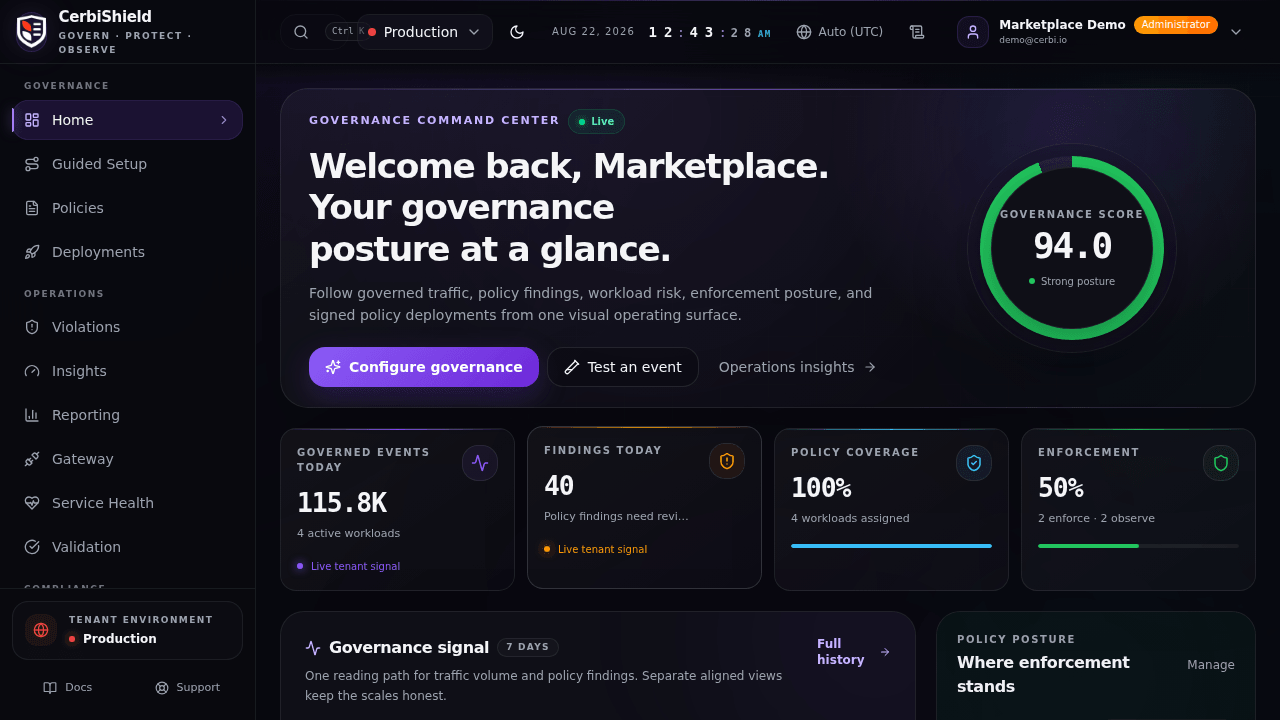
CerbiShield governance cockpit release-preview screen
Governance Cockpit: posture, coverage, enforcement, trend, workload risk, deployment activity, and readiness in one operating surface.

Validation Lab

Test policy before changing enforcement.

CerbiShield Validation Lab release-preview screen
The release-preview UI separates parsing, policy evaluation, and the final decision so a test can be explained before rollout.

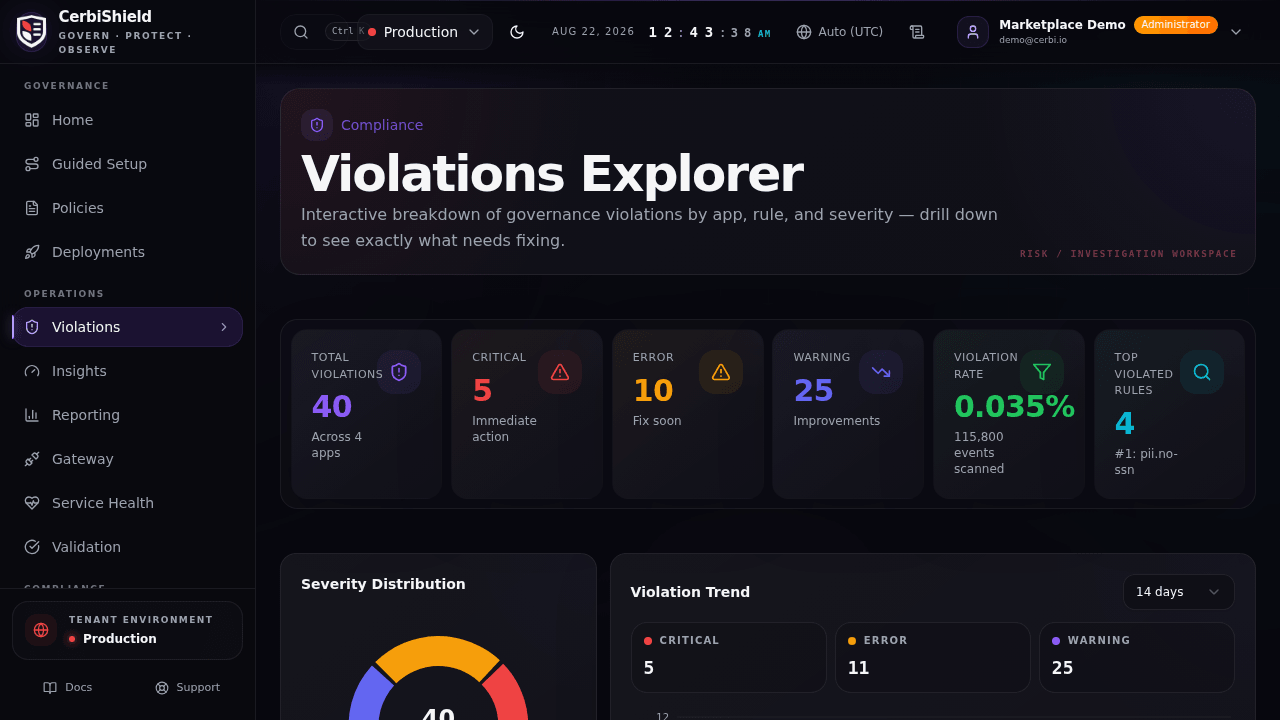
Violations Explorer

Move from posture to investigation.

CerbiShield Violations Explorer release-preview screen
This preview contains an empty-state capture because no customer workload was connected; the investigation workflow itself is the product proof shown here.

Every surface should prove something.

The current Dashboard candidate contains dedicated operational surfaces rather than one executive score page. The useful question is what decision each surface helps a team make.

Overview / governance cockpit

The operational landing view brings governance posture, workload metrics, trend signals, attention items, and platform health into one place so teams can see where action is required.

What it proves

Is governance healthy right now?

Rules

Create and inspect governance rules using templates, guided composition, and structured editing. Validate compatibility before choosing a target and environment for deployment.

What it proves

What policy are we asking the platform to enforce?

Deployments

Manage deployment targets and review rollout state, target context, environment, status, and deployment detail rather than treating policy as an untracked configuration file.

What it proves

Where is this policy active?

Violations

Move from severity and trend views into workload, rule, profile, field, and time-window drill-down so remediation starts from evidence instead of an aggregate score alone.

What it proves

What is violating policy, and where?

Validation

Exercise governance rules against representative payloads before promotion into a live enforcement path and inspect field-level results before a rollout.

What it proves

Will the policy behave the way we expect?

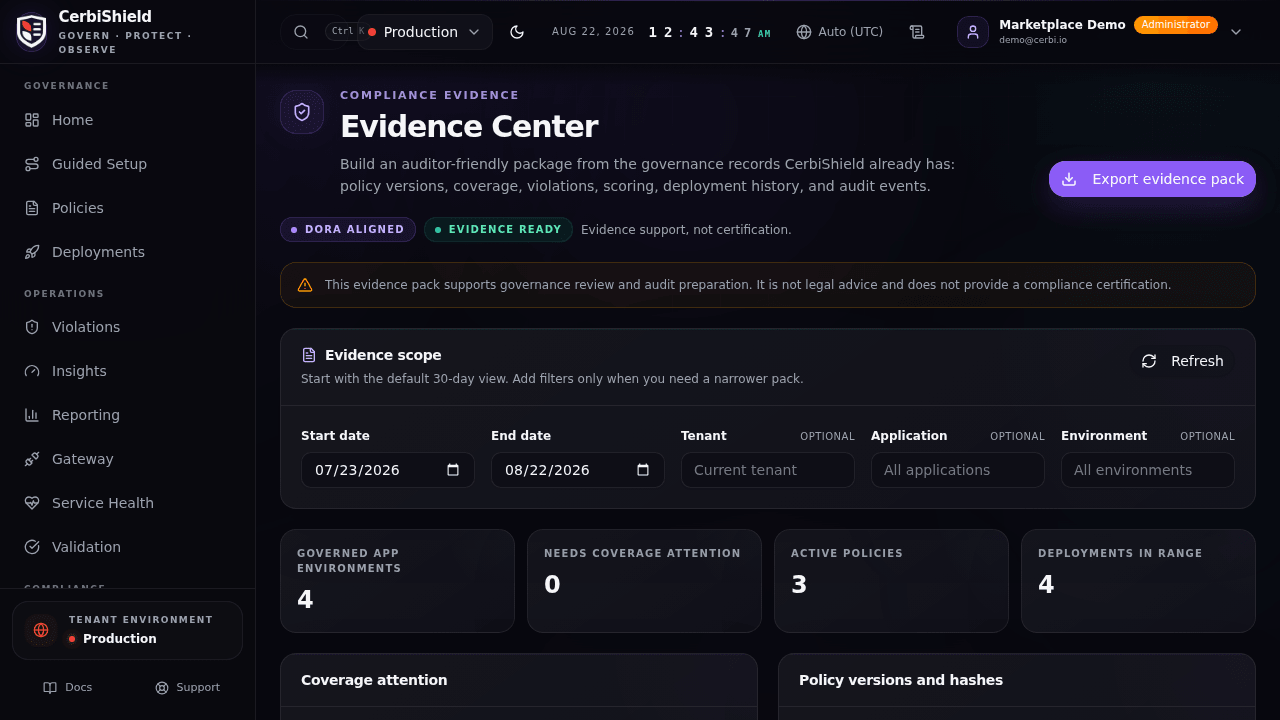
Evidence

Keep bounded governance evidence around policy decisions and enforcement outcomes so security, engineering, and review teams can work from the same record.

What it proves

What evidence supports the control?

Insights + reporting

Track governance score, coverage, violation and deployment trends, usage, and other operational signals over time instead of evaluating governance only during an audit window.

What it proves

Are we improving or regressing?

Audit

Review actor, action, resource, target, version, status, and timestamp context around governance changes and operational activity.

What it proves

Who changed what, and when?

Health

Inspect service health, response-time signals, queue and database state, routing activity, errors, and other platform-operability indicators from the same environment.

What it proves

Is the governance platform itself healthy?

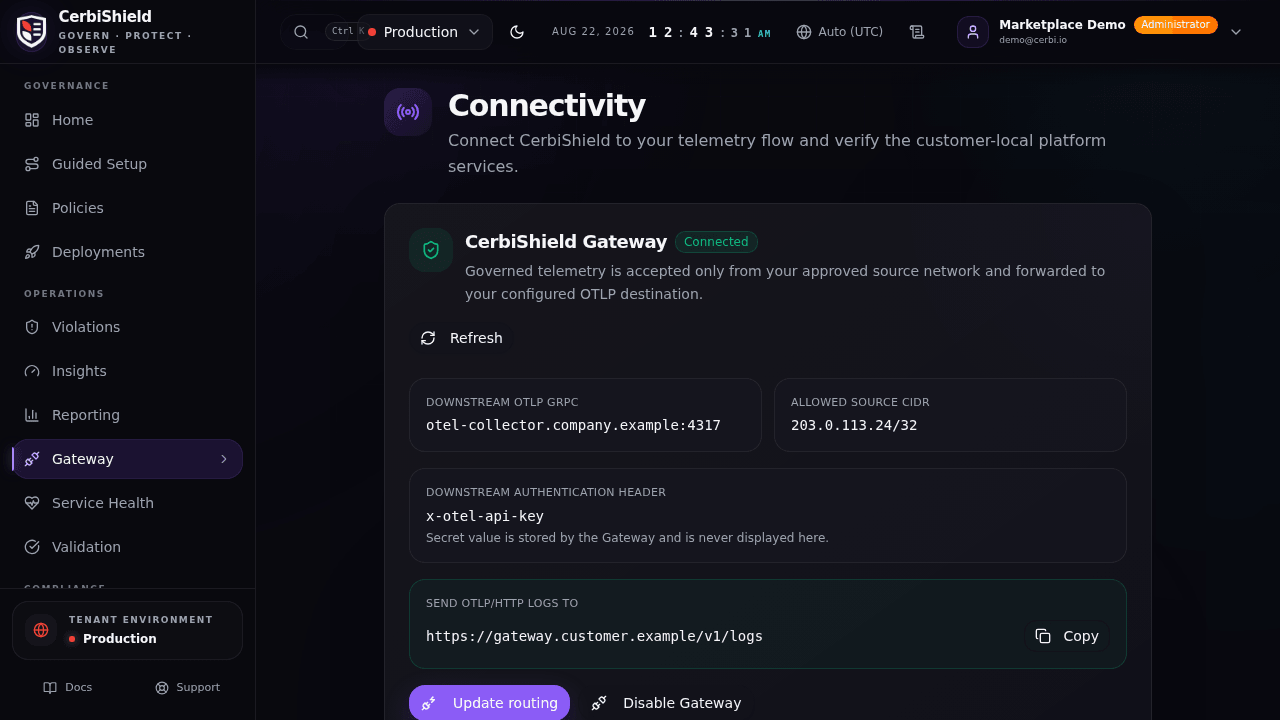
Connectivity

Make the relationships between the Dashboard, routing layer, internal services, and customer-hosted dependencies visible during setup and diagnosis.

What it proves

Can the control plane reach what it depends on?

Gateway is the data path. CerbiShield is the operating model around it.

The Dashboard does not need to become another log viewer. Its job is to manage the governance state around the telemetry path: which policy was signed, where it was targeted, whether deployment succeeded, what violations occurred, and whether the platform is healthy.

Explore Gateway

CerbiShield

Policy · targets · deployment · evidence

Cerbi Gateway

Verify · govern · forward

Dashboard

Violations · health · audit · reporting

Existing backend

Search · alert · retain · visualize

Designed for a team, not one developer's config file.

Microsoft Entra authentication for the Dashboard
Role-aware UI and permission-aware administrative actions
Customer-hosted CerbiShield services and databases
Target- and environment-aware policy deployment
Live service health and operational diagnostics
Optional AI assistance; core governance does not require AI

AI is an assistant, not a dependency.

The current Dashboard includes AI-oriented surfaces and actions for contextual assistance. Core governance still works without AI: policy definition, validation, deployment, Gateway/CerbiStream enforcement, evidence, reporting, audit, and health remain deterministic platform functions.

That separation matters in regulated environments where AI use may be restricted independently from the governance control itself.

The Dashboard is useful when it can explain the control after the change.

A walkthrough should follow one policy from definition through validation, deployment, enforcement, violation/evidence review, and health rather than bouncing between pretty screens.

Request a Dashboard walkthrough

[ cerbi ] · Choose the boundary

Use CerbiStream inside selected applications, Cerbi Gateway at the OpenTelemetry boundary, or both. CerbiShield controls signed policy, rollout, evidence, and audit across either path.

One initial workload/Customer-hosted in Azure/No raw-log relay
CerbiShield Dashboard — Control + Evidence Plane | Cerbi