Govern before the backend
Apply policy on the OTLP path before telemetry is copied into indexes, archives, alerts, dashboards, and secondary destinations.

Route existing OTLP workloads through a customer-hosted enforcement boundary, verify signed policy, retain bounded governance evidence, and keep the observability stack you already operate.
 Interactive proof
Raw telemetry
user.email = maya@example.com
Policy decision
REDACT
user.email → [REDACTED]
What Gateway does
Gateway handles the enforcement point. CerbiShield handles the policy lifecycle around it.
Apply policy on the OTLP path before telemetry is copied into indexes, archives, alerts, dashboards, and secondary destinations.
Workloads that already emit OTLP can usually be adopted by changing an endpoint or Collector route rather than modifying application logging code.
Gateway requires signed Runtime Policy Bundles so policy authenticity is part of the runtime contract rather than an operational convention.
Forward governed telemetry to the downstream OTLP destination while preserving the analytics, alerting, retention, and incident workflows already in place.
CerbiShield records bounded policy, deployment, decision, exception, and operational evidence without becoming the raw telemetry destination.
Runtime policy is cached locally, downstream export is queued and retried, and health probes make Gateway observable as a production service.
Security boundary
The deployment model makes ingress, signing, policy storage, and downstream transport explicit rather than hiding them behind a generic “secure by default” claim.
Runtime contract
Gateway uses the mechanics expected on an OTLP data path: strict request boundaries, cached policy, queued export, retries, health probes, and horizontal scaling. The baseline below was measured against the shipped v1.10.80 Azure deployment.
See performance evidenceOTLP/HTTP
Customer ingress: HTTPS /v1/logs on port 443; internal backend target: 4318
Request boundary
Strict OTLP request validation before processing
Policy refresh
Signed runtime policy is refreshed and cached locally
Downstream delivery
Queued export with bounded retry behavior
Health
Dedicated liveness and readiness probes
Scale
Plan-controlled horizontal scaling and replica replacement
Three 20-second runs, 50 events per 13.6-KiB request, 32 client workers, internal HTTPS, one 0.5-vCPU / 1-GiB replica, signed observe-mode policy, dormant debug exporter. That normalizes to roughly 38K events/sec or 10.2 MiB/sec per vCPU. All requests returned HTTP 200 with zero client errors; p95 request latency was 194–197 ms. Peak working set was about 79 MiB and CPU reached the half-core ceiling. No downstream destination was active, and the normalized figures are not a linear-scaling claim.
CerbiStream + Gateway
Use CerbiStream when control should execute inside selected applications. Use Gateway when existing OTLP workloads need a shared boundary with less application integration. Mixed estates can use both.
CerbiStream
Policy executes inside the application before the first telemetry network hop. Best for selected workloads where application-level control is worth the integration.
Explore CerbiStreamCerbi Gateway
Policy executes on the OpenTelemetry path inside the customer environment. Best when workloads already emit OTLP and should not each take a Cerbi SDK dependency.
Read Gateway architectureWhy Cerbi instead of processor config?
OpenTelemetry processors are useful building blocks. Cerbi adds the governed policy lifecycle: authoring, signing, targeting, rollout, exceptions, evidence, and one model across in-process and OTLP enforcement.
Questions architects ask
No. A workload that already emits OTLP can usually be routed through Gateway without adding a Cerbi application package. If it emits no OTLP today, it still needs standard OpenTelemetry instrumentation, an agent, a platform integration, or a Collector.
No. Gateway is built for the OpenTelemetry data path and can sit alongside or behind existing Collectors. Cerbi adds the governance system around policy distribution, verification, enforcement, exceptions, and evidence.
No. Those platforms remain downstream. Cerbi governs telemetry before it reaches them.
Cerbi does not operate a hosted raw-log relay for Gateway. Processing and forwarding occur in the customer environment; CerbiShield retains bounded governance and operational evidence rather than serving as the raw telemetry destination.
A live v1.10.80 baseline sustained 19.1K–19.5K events/sec with 50-event OTLP/HTTP batches on one 0.5-vCPU, 1-GiB replica in observe mode. Normalized, that is approximately 38K events/sec or 10.2 MiB/sec per vCPU—useful sizing perspective, not proof of linear scaling. Every measured request returned HTTP 200. This was a bounded benchmark with the dormant debug exporter, not a plan-wide capacity promise or downstream-forwarding SLA. Payload, policy, batching, destination, and scale settings materially change throughput.
Gateway is available as an optional CerbiShield enforcement path. It deploys dormant by default and exposes no public OTLP ingress until a customer explicitly configures the route, approved source boundary, and downstream destination.
Customer-controlled activation
Gateway remains dormant until you configure it. Start with a bounded workload, one representative policy decision, downstream verification, and the evidence needed to explain what happened.
Gateway in the product
The Gateway workspace separates customer telemetry-path readiness from control-plane health and makes the Applications → Gateway → Governance Policy → Existing Observability route explicit.
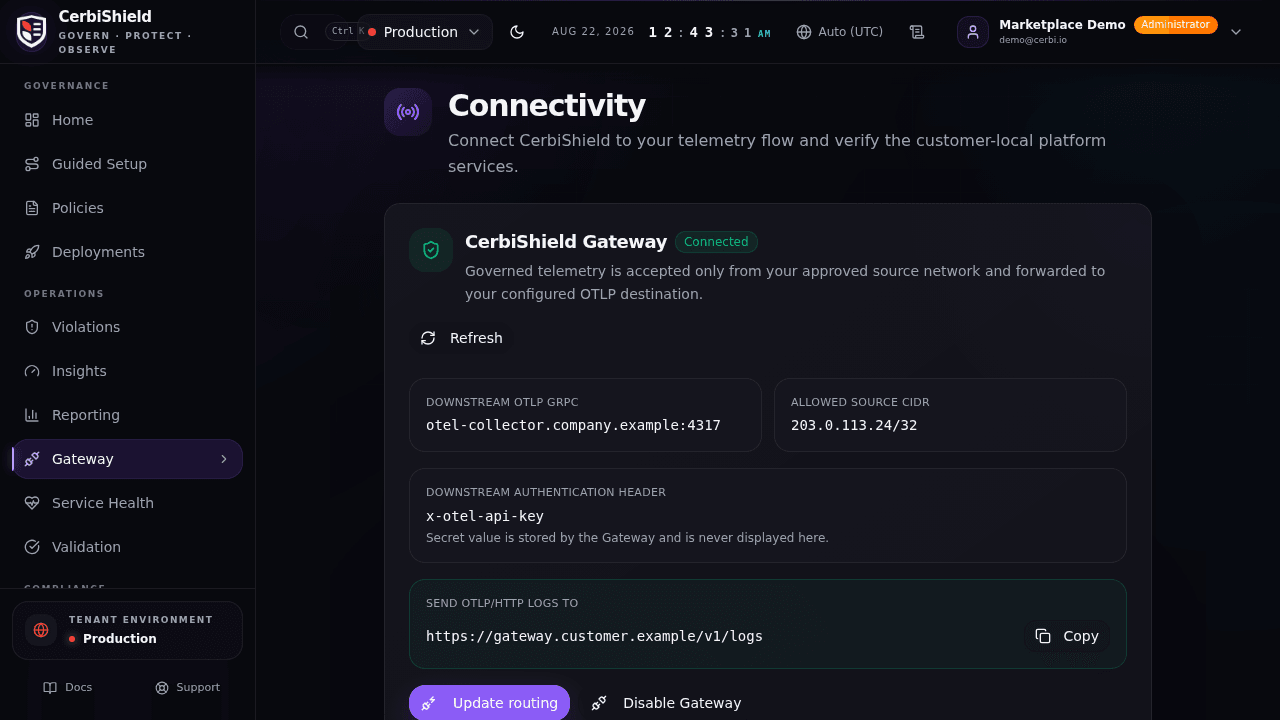
Use CerbiStream inside selected applications, Cerbi Gateway at the OpenTelemetry boundary, or both. CerbiShield keeps policy, rollout, violations, audit, and evidence under one governance program.