AI logging governance / Pro++ optional capability
Govern the logs
your AI workloads emit.
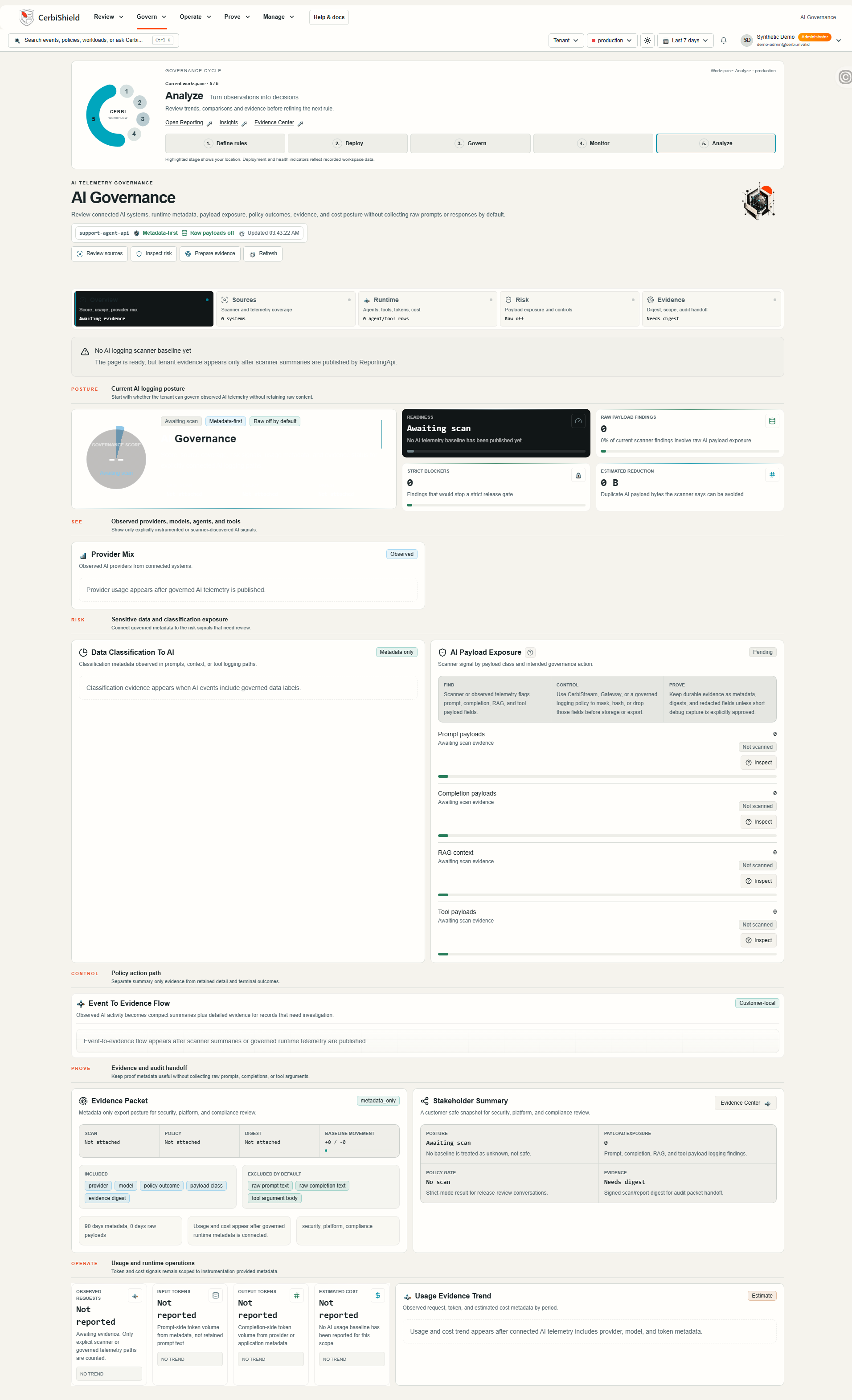
Use the same application logging policy and evidence lifecycle for supported AI-related logs. Review provider, model, agent, and tool metadata where applications emit it through connected logging paths.
Illustrative AI preview. Example values are not tenant observations; this preview does not collect tenant AI telemetry.
Metadata first
Context you can use.
Collection you control.
Raw prompts, responses, secrets, and sensitive payloads are not collected by default. Customers explicitly connect the paths they want observed and governed.
AI Logging Governance is the Pro++ product capability behind this view. It is separate from Cerbi’s optional rule-writing AI assistant.
Available / connected sources
Visibility with a defined scope.
| Capability | Current scope |
|---|---|
| Observed AI logging context | Applications and AI dependencies represented in connected logging and scanner evidence; not a complete AI estate inventory. |
| Provider and model visibility | Provider/model metadata supplied by instrumented applications. |
| Agent and tool context | Named agents, tools, and operations where the integration emits that context. |
| Sensitive fields in AI-related logs | Logged-field classifications and protected-field evidence on supported AI logging paths; not inspection of every model interaction. |
| Dependency discovery | Supported AI dependency patterns found by repository/CI scanning; distinct from runtime observation. |
| Usage and estimated cost | Request and token counts, latency, and estimated cost where observations provide the metadata. |
| Policy and evidence | Recorded governance outcomes, profile context, payload digests, and protected evidence for review. |
Logging policy applies at supported application/runtime or OTLP log boundaries. Logged agent or tool context is evidence about a log event; it does not authorize agent actions or control execution.
Explicit product boundary
Execution control is
a separate boundary.
Agent-action authorization, arbitrary model behavior, and universal tool-call enforcement are not included in AI Logging Governance. An evaluation should test a logging-control requirement, not a generalized AI security or compliance promise.
There is no claim of universal AI discovery or full estate coverage without instrumentation. Evidence can support governance and audit readiness; it does not certify compliance.
Review separately scoped roadmapOptional in Pro++.
$299/month now for up to 10B governed events; $999/month from February 1, 2027 UTC. Confirm your market’s price and renewal terms in Microsoft Marketplace; Azure infrastructure costs are separate. Enable AI Logging Governance through Pro++ plan configuration. Trial, One, and Pro keep it off.
View approved pricingKeep your observability stack.
Govern AI-related logs on the connected path, then continue to your existing destinations. CerbiShield runs in your Azure tenant.
Review the architectureA founder-led logging-risk review
Find the control gap.
Test one workload.
Bring a Scanner finding, a sensitive-field concern, or an evidence requirement. Compare existing controls first. If a gap remains, agree one workload, one policy, an evaluation window, and evidence to review before deciding on a recurring CerbiShield deployment.